
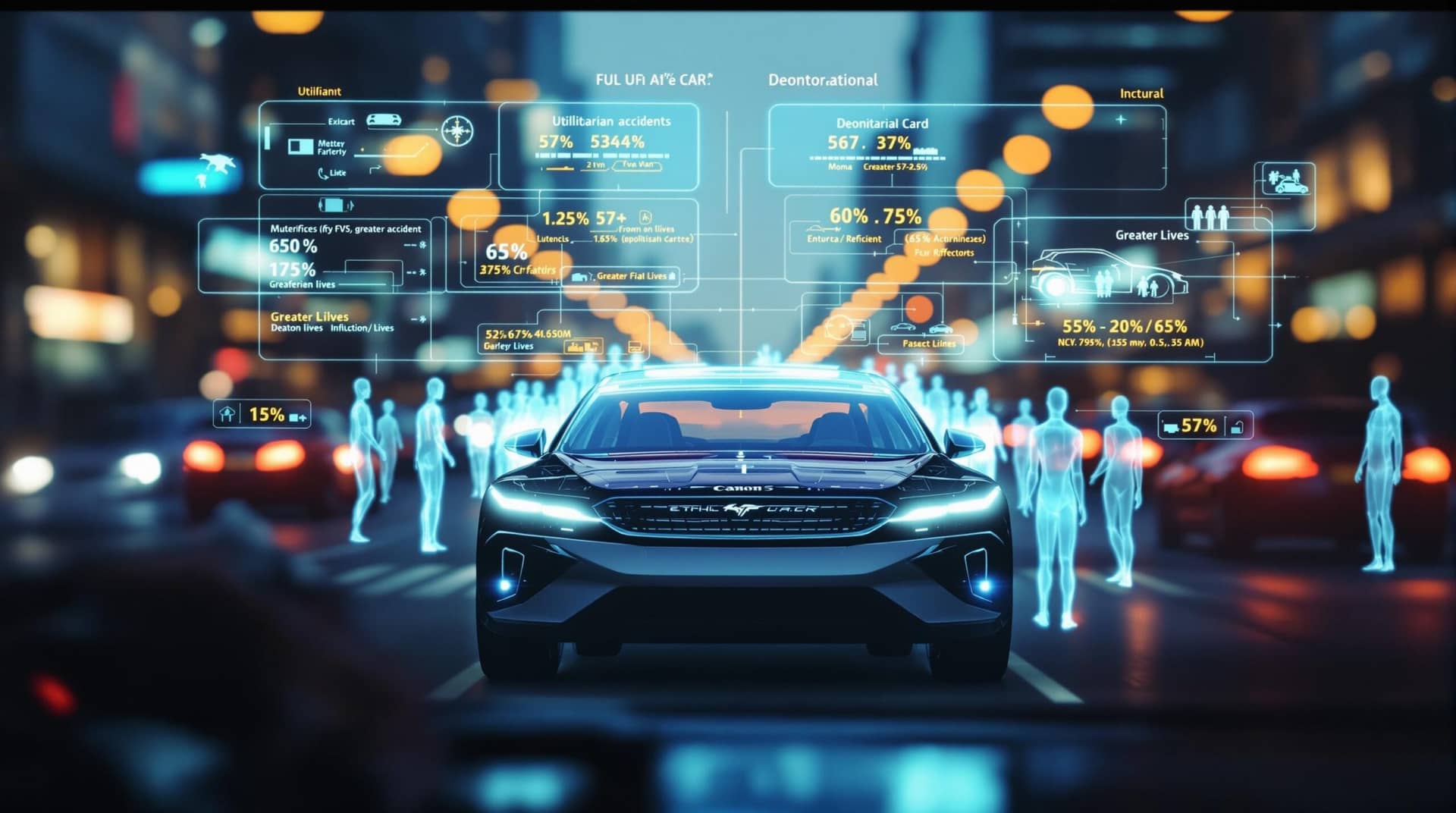
Maybe you’ve found yourself in a situation where the right choice wasn’t clear—where every option carried real costs and no path forward felt clean. The MIT Moral Machine experiment collected 39.61 million answers from 1.3 million respondents across 233 countries and territories, transforming abstract philosophical thought experiments into urgent practical questions. When self-driving cars face unavoidable accidents, algorithms must make split-second decisions that raise profound moral dilemmas about who lives and who dies. These scenarios force us to confront uncomfortable truths about values, accountability, and whether machines can—or should—bear moral responsibility. Moral dilemmas in autonomous vehicles are not rumination or venting about hypothetical scenarios. They are structured observations that reveal patterns about human judgment, the limits of technology, and the future of AI-driven decision-making.
Quick Answer: Moral dilemmas in autonomous vehicles present impossible choices between unavoidable harms, revealing that technology can amplify human values but cannot replace human accountability—experts increasingly argue machines should follow traffic laws rather than act as independent moral agents.
Definition: Moral dilemmas in autonomous vehicles are situations where algorithms must choose between unavoidable harms in split-second decisions, forcing programmers to encode ethical principles into machine behavior.
Key Evidence: According to research published by the National Center for Biotechnology Information, participants show “a stronger tendency to prefer self-driving cars to act in ways to minimize harm” compared to human drivers, expecting higher ethical standards from machines.
Context: These moral dilemmas illuminate questions about responsibility, dignity, and whether moral judgment can—or should—be delegated to algorithms.
Moral dilemmas in autonomous vehicles work because they externalize value conflicts that usually remain hidden in human intuition, forcing explicit choices about whose lives matter more in unavoidable accidents. When programmers must write code that determines who survives a crash, abstract principles become concrete decisions with life-or-death consequences. The benefit comes not from solving these moral dilemmas but from revealing what they teach us about accountability, human dignity, and the proper relationship between human wisdom and machine capability. What follows examines how these impossible choices emerged from philosophy into engineering practice, why delegating moral agency to machines breaks accountability chains, and what practical pathways forward preserve human responsibility while using technological capability.
Key Takeaways
- Global moral preferences show surprising consensus but shouldn’t dictate algorithmic ethics—popularity doesn’t equal wisdom
- Accountability gaps emerge when machines make moral choices—experts warn this breaks chains of human responsibility
- Regulatory frameworks like Germany’s 2017 guidelines prohibit demographic distinctions, affirming human dignity over utilitarian calculations
- Law-following approaches maintain predictability and trust better than complex moral algorithms
- Collaborative systems may dissolve moral dilemmas through vehicle communication rather than forcing impossible individual choices
The Trolley Problem Becomes Reality: Understanding Autonomous Vehicle Moral Dilemmas
You might recall the trolley problem from a philosophy class or late-night conversation—that thought experiment about whether to redirect a runaway trolley to kill one person rather than five. For decades, this remained an abstract question explored in university seminars. But as autonomous vehicles moved from laboratory prototypes to public roads throughout the 2010s, engineers confronted a stark reality. Algorithms would need to make decisions in scenarios where human drivers rely on instinct, emotion, and split-second moral judgment that machines cannot replicate.
The MIT Moral Machine platform collected 39.61 million answers from 1.3 million respondents across 233 countries and territories in just two years, according to analysis by the Montreal AI Ethics Institute. This data collection revealed global preferences—saving many over few, young over old—but it also exposed a deeper problem: reducing moral wisdom to popularity contests. Moral dilemmas in autonomous vehicles are situations where algorithms must choose between unavoidable harms in split-second decisions, programming into machines the ethical questions humanity has debated for centuries.
What makes these moral dilemmas particularly challenging is the gap between what we believe abstractly and what we’re willing to accept personally. Research reveals global patterns in moral intuition, but these patterns don’t necessarily reflect what should guide life-and-death decisions. A consensus that emerges from voting—even at massive scale—cannot substitute for principled moral reasoning. The data tells us what people prefer, not what wisdom demands.

Why Traditional Human Judgment Fails Machines
Human drivers rely on instinct, emotion, and split-second intuition that algorithms cannot replicate. Studies show “human drivers and self-driving cars were largely judged similarly” overall, according to research published by the National Center for Biotechnology Information. The same research found people expect machines to embody aspirational ethics rather than mirror human imperfection. This expectation reveals something worth noticing: we demand higher moral standards from technology than from ourselves. That tension—between what humans do and what we expect machines to do—sits at the heart of autonomous vehicle ethics.
The Accountability Problem: Why Machines Cannot Be Moral Agents
The Montreal AI Ethics Institute articulates a concern worth considering: “Autonomous systems are not moral agents and so in the case these systems apply automated ethical decision making, the chain of moral responsibility breaks down.” This represents more than philosophical hairsplitting. It identifies a category error that threatens to obscure rather than clarify responsibility. Technology can extend human capability, but it cannot absorb human accountability.
When an autonomous system makes a decision that results in harm, legal and ethical frameworks struggle to assign responsibility. Is the programmer liable for code decisions made years before deployment? The manufacturer for design choices embedded in the vehicle? The owner for choosing to deploy the technology? Or does introducing machine agency disrupt traditional responsibility chains in ways that require entirely novel frameworks? These questions remain philosophically unsettled, though vehicles operate on public roads today.
Germany’s Federal Ministry of Transport issued 2017 guidelines that offer a different approach. According to research reviewing these frameworks, the guidelines prohibit personal distinctions based on age, gender, or social status in unavoidable accident scenarios. This regulatory stance affirms that human dignity cannot be quantified or compared. It represents wisdom rooted in the intrinsic worth of each person—a principle that transcends efficiency calculations and demands character-driven decision-making.
Leaders who attempt to outsource moral judgment to algorithms abdicate their responsibility to stakeholders, breaking the chain of accountability that sustains trust. The attempt to program moral agency into machines doesn’t solve ethical problems—it obscures who bears responsibility when things go wrong. That obscurity serves no one except those seeking to avoid accountability.
The Law-Following Alternative
Stanford HAI experts advocate that autonomous vehicles should always uphold “duty to other road users” by obeying traffic laws, according to Stanford Human-Centered Artificial Intelligence. This approach explicitly rejects programming vehicles to match human behaviors like speeding. It grounds ethical AI in established social contracts rather than novel moral theories. Trust emerges from predictable adherence to shared norms, not from opaque algorithmic optimization. When vehicles consistently follow laws, responsibility chains remain intact and accountability stays with human decision-makers where it belongs.
Practical Pathways Forward: From Impossible Choices to Better Systems
The most promising direction shifts the paradigm entirely. Rather than programming individual vehicles to make tragic choices, we can design systems that prevent moral dilemmas from arising in the first place. Patrick Lin proposes allowing self-driving vehicles to communicate, enabling “multiple vehicles could work in unison to allow a safe pathway out” rather than forcing impossible individual choices, according to his TED presentation. This reframes ethics from zero-sum calculation to collaborative problem-solving.
For leaders navigating AI adoption in any domain, several principles emerge. First, maintain human accountability regardless of automation level. Establish clear chains of responsibility that specify which human decision-makers bear accountability for algorithmic choices. Never allow technical sophistication to obscure moral ownership. Second, design AI systems that amplify rather than replace human judgment in consequential decisions. Let algorithms handle pattern recognition within defined parameters while humans retain responsibility for value-laden choices.
Third, establish bright-line rules based on human dignity that remain inviolable regardless of aggregate consequences. Germany’s prohibition on demographic distinctions offers a template: identify values that must remain sacred even when efficiency metrics suggest otherwise. A common mistake to avoid is attempting to quantify the unquantifiable. Not everything that matters can be measured, and not everything measurable matters equally.
Research reveals that stakeholder position influences ethical judgment. According to studies examining moral perspectives, pedestrians favor actions that endanger car occupants over themselves, though this preference diminishes when the vehicle is self-driving rather than human-operated. This finding underscores the need for extensive stakeholder consultation that genuinely incorporates diverse perspectives. No single viewpoint captures the full moral landscape. Ethical wisdom emerges from dialogue rather than individual reasoning.
The path forward requires integrating timeless principles of stewardship and responsibility with unprecedented capabilities of machine intelligence—technology as amplifier of human values, not replacement for human discernment. This means asking different questions. Not “what should the algorithm do in this situation?” but “how do we design systems that minimize the probability of such situations arising?” That reframing redirects energy from impossible choices to preventive wisdom.
Emerging Trends and Unresolved Questions
The most significant trend involves moving from isolated vehicle decision-making toward networked systems that enable collaborative avoidance. Rather than programming individual cars to choose between unavoidable harms, future architectures may allow multiple vehicles to communicate and coordinate, potentially dissolving moral dilemmas before they crystallize into tragic choices. This represents a paradigm shift from optimizing within constraints to redesigning systems that create those constraints.
Regulatory frameworks are gravitating toward law-following as the primary ethical standard rather than expecting vehicles to make complex utilitarian calculations. This approach offers clear advantages: it maintains chains of accountability, aligns with existing legal structures, and provides predictability that builds public trust. There is also growing skepticism about treating public opinion surveys as normative guides. Ethics cannot be determined by voting. Wisdom requires reasoned deliberation and commitment to values that transcend popularity.
Significant knowledge gaps remain. The field lacks data on actual crash scenarios—current studies rely on hypothetical scenarios and simulations, making ethical frameworks largely theoretical until real-world experience accumulates. There is also an unresolved tension between public moral approval and personal purchasing decisions. Research suggests people accept harm-minimizing vehicles as ethically superior but hesitate to buy cars programmed to sacrifice occupants. This gap between abstract principle and self-interest points to questions about how ethical ideals translate into market behavior.
Multi-vehicle coordination ethics remains largely unexplored. When autonomous vehicles communicate collaboratively, new questions emerge about distributing benefits and risks across participating vehicles. What happens when vehicles from different manufacturers with different ethical programming interact? Can collective systems resist manipulation? Some observers warn that focusing extensively on dramatic but rare moral dilemmas may serve manufacturer interests by distracting from more common safety issues and liability questions. Current autonomous vehicle ethics reveals that moral dilemmas illuminate genuine value conflicts requiring human wisdom rather than algorithmic resolution—no amount of data can substitute for principled reasoning.
Why Moral Dilemmas in Autonomous Vehicles Matter
Moral dilemmas in autonomous vehicles matter because they force us to confront questions we’ve long avoided about accountability, dignity, and the proper relationship between human judgment and machine capability. These are not abstract philosophical exercises. They are practical challenges that will shape how technology integrates into society and whether that integration preserves or erodes human responsibility. The decisions we make now about autonomous vehicle ethics will establish precedents for AI systems across every domain—from healthcare to criminal justice to financial services. What we’re deciding is whether technology serves human values or replaces human discernment.
Conclusion
Moral dilemmas in autonomous vehicles expose the truth that machines can extend human capability but cannot replace human accountability or judgment. Rather than programming vehicles as independent moral agents—an approach that breaks chains of responsibility—the path forward emphasizes law-following, collaborative systems, and maintaining clear lines of human accountability. These challenges illuminate principles for all AI adoption: technology should amplify our values while preserving human discernment in consequential decisions. Leaders navigating AI implementation must resist the temptation to outsource moral judgment to algorithms and instead design systems that keep humans accountable for value-laden choices. The question is not what machines should decide, but how we design technology that supports rather than supplants human wisdom. For more on maintaining ethical integrity in AI systems, see our guide on AI ethics beyond compliance, our framework for understanding ethical dilemmas, and our overview of ethical dilemmas in leadership.
Frequently Asked Questions
What are moral dilemmas in autonomous vehicles?
Moral dilemmas in autonomous vehicles are situations where algorithms must choose between unavoidable harms in split-second decisions, forcing programmers to encode ethical principles into machine behavior when accidents cannot be prevented.
Why can’t machines be moral agents in self-driving cars?
Machines cannot be moral agents because they break the chain of moral responsibility. When autonomous systems make ethical decisions, it becomes unclear who bears accountability—the programmer, manufacturer, or owner.
What did the MIT Moral Machine experiment reveal?
The MIT Moral Machine collected 39.61 million answers from 1.3 million respondents across 233 countries, revealing global preferences like saving many over few and young over old, but showing popularity cannot substitute for principled moral reasoning.
How should autonomous vehicles handle unavoidable accidents?
Experts increasingly advocate that autonomous vehicles should follow traffic laws rather than make complex moral calculations. Germany’s 2017 guidelines prohibit demographic distinctions, affirming human dignity over utilitarian calculations.
What is the difference between human and machine moral judgment?
Human drivers rely on instinct, emotion, and split-second intuition that algorithms cannot replicate. Research shows people expect higher ethical standards from machines than from human drivers, creating unrealistic expectations.
How can collaborative vehicle systems solve moral dilemmas?
Future networked systems may allow multiple vehicles to communicate and coordinate, potentially dissolving moral dilemmas before they crystallize into tragic choices rather than forcing impossible individual decisions.
Sources
- Montreal AI Ethics Institute – Critical analysis of Moral Machine methodology and arguments against machine-readable ethics and voting-based moral frameworks
- National Center for Biotechnology Information – Research studies using virtual reality to examine moral judgments of autonomous vehicles from multiple stakeholder perspectives
- Stanford Human-Centered Artificial Intelligence – Expert perspectives on law-following frameworks and accountability in autonomous vehicle design
- MIT Moral Machine – Platform for crowd-sourced data collection on moral preferences in autonomous vehicle dilemma scenarios
- TED – Philosophical perspectives on collaborative vehicle communication as alternative to isolated ethical decision-making